

Can Gel Injections Help Bone-on-Bone Knees? Non-Surgical Relief
If you have been told that your knee is “bone-on-bone,” you already know the sharp ache that comes with every step, the stiffness that settles in after sitting too long, and the frustration of watching activities you love become harder. The term itself sounds final, as though the joint has reached a point of no return. But in clinical practice, bone-on-bone does not always mean surgery is the only path forward. Many patients explore non-surgical options, and one of the most discussed is the use of gel injections for bone-on-bone knees.
This article explains what bone-on-bone knee arthritis actually means, how gel injections work, who may benefit, and what the evidence says about their effectiveness. We also compare them with other non-surgical treatments, review the injection procedure itself, and answer common questions about recovery and longevity. By the end, you will have a clearer picture of whether this approach fits your situation and what questions to ask your provider.
.
What Does ‘Bone-on-Bone’ Mean in Knee Osteoarthritis?
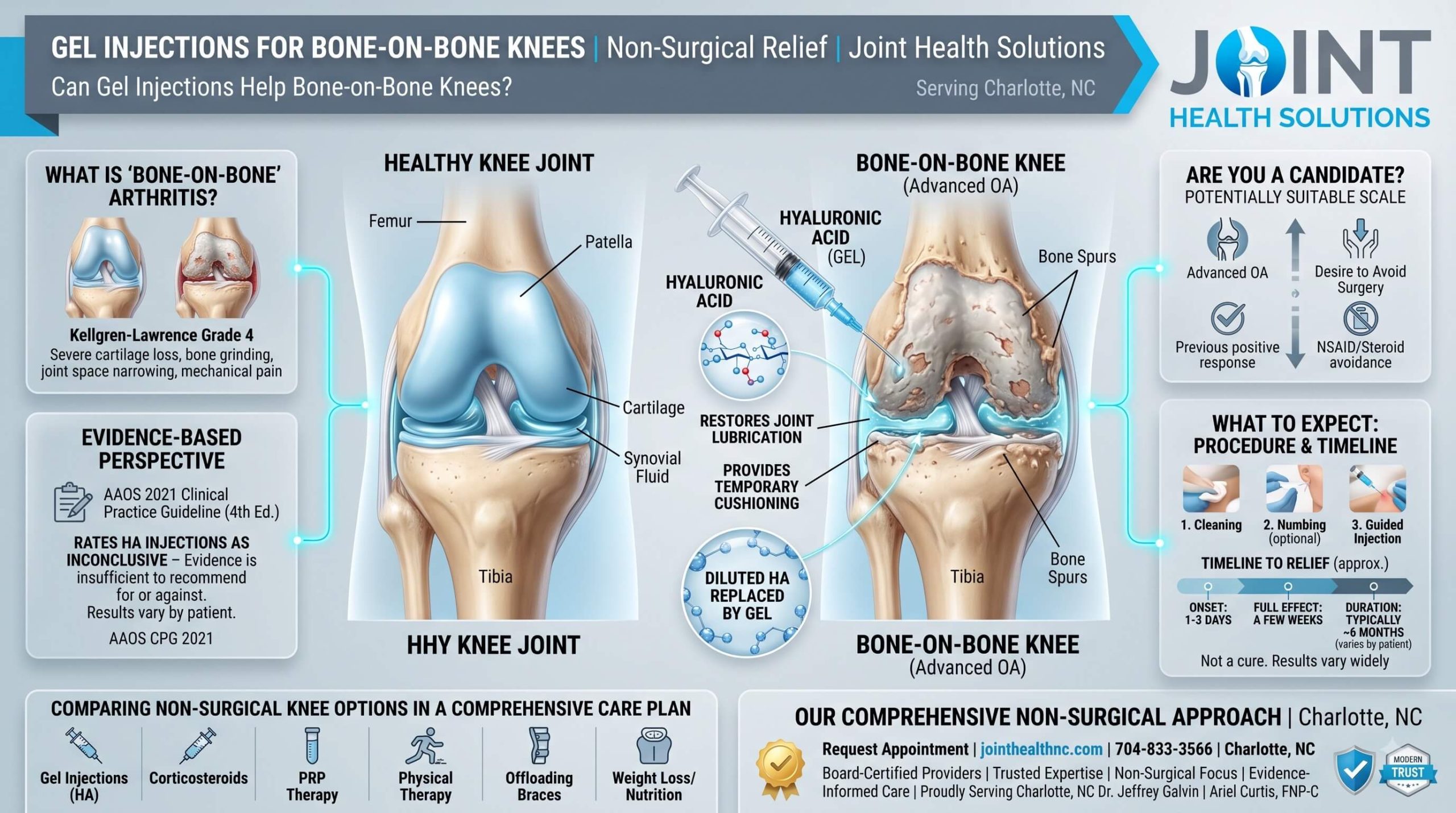
Osteoarthritis (OA) is the most common form of arthritis, affecting millions of adults worldwide. In a healthy knee, a smooth layer of cartilage covers the ends of the thigh bone (femur), shin bone (tibia), and the back of the kneecap (patella). This cartilage acts as a shock absorber and allows the bones to glide smoothly during movement. It also provides a low-friction surface that distributes load across the joint.
In osteoarthritis, this cartilage gradually wears away. As the disease progresses, areas of the joint may lose most or all of their protective covering. When the cartilage becomes so thin that the underlying bones come into direct contact, clinicians describe the joint as “bone-on-bone.” This is usually visible on an X-ray as a narrowing of the joint space, often to the point where little or no space remains between the bones.
Bone-on-bone is not a formal medical diagnosis but a descriptive term that reflects the severity of joint space loss. It typically corresponds to Kellgren-Lawrence grade 4, the most advanced stage of knee OA. At this stage, the joint may also develop bone spurs (osteophytes), subchondral sclerosis (thickening of the bone beneath the cartilage), and cysts. These changes contribute to pain, swelling, stiffness, and reduced range of motion.
The pain from bone-on-bone OA is often mechanical, meaning it worsens with weight-bearing activities like walking, climbing stairs, or standing for long periods. Some patients also experience pain at rest or at night, which can disrupt sleep. The joint may feel unstable or give way, and a grinding sensation (crepitus) is common. While the structural damage is significant, the degree of pain and disability varies widely from person to person. Some people with severe X-ray changes have surprisingly mild symptoms, while others with moderate changes experience severe pain. This variability is important because it means treatment decisions should be based on the whole picture, not just the X-ray.
Understanding the anatomy helps explain why gel injections might be considered. Even in an advanced arthritic joint, there is often some remaining synovial fluid, but its quality and quantity are reduced. The synovial fluid normally contains hyaluronic acid, a large sugar molecule that gives the fluid its viscous, elastic properties. In OA, the concentration and molecular weight of hyaluronic acid decrease, making the fluid thinner and less capable of cushioning the joint. Viscosupplementation aims to restore some of these properties by injecting a gel-like substance directly into the joint.
How Gel Injections Work to Cushion the Knee Joint
Gel injections for knee osteoarthritis are known medically as viscosupplementation. The “gel” is a preparation of hyaluronic acid (HA), a naturally occurring substance found in high concentrations in synovial fluid and cartilage. HA gives synovial fluid its shock-absorbing and lubricating qualities. In an osteoarthritic knee, the natural HA becomes diluted and degraded, contributing to increased friction and damage.
When HA is injected into the joint, it supplements the existing synovial fluid. The goal is to restore some of the viscoelastic properties that are lost in OA. This can improve joint lubrication, reduce friction, and potentially provide a cushioning effect that may help with pain during movement. Additionally, HA may have anti-inflammatory and pain-modulating effects, though the exact mechanisms are not fully understood. Some research suggests HA can inhibit inflammatory mediators and protect cartilage cells from further damage, but these effects are not firmly established in human studies.
The injected HA is eventually broken down and cleared by the body, which is why the effects are temporary. Depending on the product used, a course of treatment may involve one to five injections, often given weekly. Some formulations are designed to provide longer-lasting effects with fewer injections.
It is important to note that HA injections do not reverse cartilage loss or restore the joint to its pre-arthritic state. They are a symptomatic treatment that may provide pain relief and functional improvement for a period of months. The evidence for their effectiveness is mixed, and they do not work for everyone. The American Academy of Orthopaedic Surgeons (AAOS) 2021 Clinical Practice Guideline rates HA injections as “Inconclusive” for knee OA, meaning the evidence is insufficient to recommend for or against their use.
Despite this, many patients report meaningful pain relief from HA injections, and they remain a commonly used non-surgical option. The decision to try them should be made in consultation with a healthcare provider who can assess your specific situation and discuss the potential benefits and limitations.
Who Is a Candidate for Gel Injections?
Not everyone with knee OA is a good candidate for gel injections. The decision depends on several factors, including the severity of arthritis, the source of pain, overall health, and personal preferences. While bone-on-bone knees are often considered advanced, some patients still benefit from viscosupplementation, while others may not.
Generally, candidates for gel injections include:
- Adults with mild to moderate knee OA who have not found adequate relief with conservative measures such as physical therapy, weight management, or oral medications.
- Patients with moderate joint space narrowing on X-ray, though some with advanced changes may still try it.
- Individuals who wish to delay or avoid knee replacement surgery and are looking for a non-surgical option.
- Patients who cannot tolerate or have contraindications to nonsteroidal anti-inflammatory drugs (NSAIDs) or corticosteroid injections.
- Those who have had a positive response to a previous course of HA injections.
On the other hand, gel injections may be less appropriate for:
- Patients with severe bone-on-bone changes where the joint space is almost completely obliterated, as the injectable may not provide enough cushioning.
- Individuals with active knee infection, skin infection at the injection site, or bleeding disorders.
- Those who are allergic to hyaluronic acid preparations or to avian (bird) proteins, as some products are derived from rooster combs.
- Patients with significant joint instability or mechanical problems, such as a torn meniscus that requires surgical repair.
- Pregnant or breastfeeding women, due to lack of safety data.
It is also important to consider that the evidence for HA injections in severe (bone-on-bone) OA is limited. Some studies suggest that patients with less severe joint damage may respond better, but this is not absolute. A thorough evaluation by a qualified provider is essential to determine whether you are a suitable candidate.
Comparing Gel Injections to Other Non-Surgical Options
When you have bone-on-bone knee pain, you have several non-surgical options beyond gel injections. Each has its own mechanism, evidence base, and limitations. The table below summarizes the main options to help you understand the landscape.
| Treatment | How It Works | Limitations | Risks |
|---|---|---|---|
| Gel injections (HA) | Adds hyaluronic acid to supplement synovial fluid, improving lubrication and cushioning | Evidence is mixed; may not work for all; effects are temporary (months) | Pain at injection site, swelling, rare infection; allergic reactions |
| Corticosteroid injections | Potent anti-inflammatory that reduces pain and swelling | Provides short-term relief (weeks to months); repeated use may damage cartilage | Infection, nerve damage, skin thinning, cartilage damage with frequent use |
| PRP (platelet-rich plasma) injections | Concentrated platelets from your own blood are injected to release growth factors that may reduce inflammation and promote healing | Not FDA-approved as a drug; the concentration device is FDA-cleared; evidence for knee OA is mixed; requires blood draw | Pain, swelling, infection; rare nerve injury |
| Physical therapy | Strengthens muscles around the knee, improves flexibility and gait | Requires time and effort; may not relieve pain quickly | Minimal; temporary muscle soreness |
| Offloading knee braces | Redistributes load away from the damaged part of the joint | May be bulky; not all patients tolerate; does not treat the underlying process | Skin irritation, discomfort |
| Weight loss and exercise | Reduces stress on the joint and improves overall function | Requires long-term commitment; may be difficult with pain | Minimal |
| NSAIDs (oral or topical) | Reduce inflammation and pain | May cause stomach, kidney, or cardiovascular issues with long-term use | GI bleeding, kidney damage, increased cardiovascular risk |
As you can see, there is no perfect option. Gel injections offer a targeted approach that directly addresses the loss of synovial fluid viscosity, but the evidence is not strong enough to guarantee results. Corticosteroids are fast-acting but short-lived and carry risks with repeat use. PRP is a biologic option that is gaining popularity, but its efficacy is still debated. Physical therapy and weight loss are foundational and may enhance the effects of other treatments. Offloading braces can provide mechanical relief.
At Joint Health Solutions in Charlotte, North Carolina, we offer a range of non-surgical treatments for knee pain, including hyaluronic acid injections in Charlotte. Our team can help you navigate these options based on your specific condition and goals.
What to Expect During a Gel Injection Procedure
If you and your provider decide that gel injections are worth trying, you will likely have the procedure done in the clinic. Here is what you can expect:
- Preparation: You will be seated or lying down with your knee bent. The skin over the injection site is cleaned with an antiseptic solution to minimize the risk of infection.
- Numbing: A local anesthetic may be sprayed or injected to numb the skin, though some providers prefer to inject directly without numbing to avoid extra needle sticks.
- Injection: The provider inserts a thin needle into the joint space, usually on the inner or outer side of the kneecap. Sometimes ultrasound or fluoroscopy (X-ray guidance) is used to ensure accurate placement, especially in difficult cases. The gel is slowly injected.
- Post-injection: The area is cleaned again, and a small bandage is applied. You may be asked to move your knee gently to distribute the gel.
The procedure itself takes only a few minutes. Most patients tolerate it well, though some experience mild discomfort or a feeling of fullness in the joint. You can usually go home immediately afterward.
Depending on the product, you may need a series of injections. For example, some products require three weekly injections, while others are given as a single injection. Your provider will give you a specific schedule.
Before the procedure, it is important to inform your provider about all medications you take, especially blood thinners, as they may increase the risk of bleeding. You may be advised to stop certain supplements like fish oil or vitamin E a few days beforehand.
How Long Do Gel Injections Last?
The duration of pain relief from gel injections varies from person to person. In clinical studies, the effect typically lasts from several months to about six months, though some patients may experience relief for up to a year. The exact duration depends on the product used, the severity of arthritis, and individual factors such as activity level and weight.
It is important to have realistic expectations. Gel injections are not a permanent fix. They are designed to provide a period of symptomatic relief that may allow you to function better and perhaps delay more invasive interventions. Some patients choose to repeat the injections when the effect wears off, but the frequency and timing should be discussed with your provider.
If you do not experience significant relief after the first course of injections, repeating them is unlikely to produce dramatically different results. Your provider may suggest alternative treatments.
Potential Risks and Side Effects
Gel injections are generally considered safe, but like any medical procedure, they carry some risks. The most common side effects are local and include:
- Pain or soreness at the injection site
- Swelling and warmth in the knee
- Stiffness or a feeling of fullness
These effects are usually mild and resolve within a few days. More serious complications are rare but can include:
- Infection in the joint (septic arthritis) – a medical emergency
- Allergic reactions, especially in people allergic to avian proteins
- Nerve or blood vessel damage (very rare)
- Calcification of the joint (rare)
If you experience increasing pain, redness, fever, or swelling that worsens after the injection, contact your provider immediately.
Recovery and Rehabilitation After Gel Injections
Recovery after gel injections is typically quick, but it is important to follow your provider’s instructions to maximize the benefits. Immediately after the injection, you may be advised to:
- Avoid strenuous activity or heavy lifting for 24-48 hours.
- Use ice packs on the knee to reduce swelling.
- Take over-the-counter pain relievers if needed, but avoid NSAIDs for the first 24 hours as they may interfere with the gel.
Most patients can return to normal daily activities the next day, but it is wise to avoid high-impact exercises like running or jumping for at least a week. Your provider may recommend physical therapy to strengthen the muscles around the knee and improve overall joint function. A tailored exercise program can enhance the effects of the gel and help maintain mobility.
Most patients begin to notice some improvement within the first one to two weeks as the joint adjusts, though full benefit from a series of injections may take several weeks to develop. Individual response depends on the severity of your arthritis, the specific product used, and how your body responds to the injection.
Non-Surgical Options for Bone-on-Bone Knee OA: From Viscosupplementation to Offloading Braces
At Joint Health Solutions, we understand the frustration of living with bone-on-bone knee pain. Our goal is to offer a comprehensive, non-surgical approach that addresses your pain and helps you stay active. In addition to hyaluronic acid injections, we provide:
- Joint Injections: Including corticosteroid injections for acute flare-ups.
- Offloading Knee Braces: Custom-fit braces that redistribute pressure away from the damaged part of the joint.
- Physical Therapy: Targeted exercises to strengthen the supporting muscles and improve range of motion.
- Nutrition Plan: Guidance on weight management and anti-inflammatory eating to support joint health.
Our team, led by Dr. Jeffrey Galvin — Board-certified physician in Emergency Medicine and Obesity Medicine, and Ariel Curtis, FNP-C — Board-certified Family Nurse Practitioner, takes the time to understand your unique situation. We use imaging and a thorough exam to determine the best course of action. If you are considering hyaluronic acid injections in Charlotte, we can discuss whether they are appropriate for you and what to expect.
Taking the Next Step for Your Knee Pain
Living with bone-on-bone knee pain can be exhausting, but you do not have to accept it as inevitable. Gel injections for bone-on-bone knees may offer a non-surgical path to relief for some patients, but the decision requires careful evaluation. At Joint Health Solutions in Charlotte, North Carolina, we are dedicated to helping you find a treatment plan that fits your lifestyle and goals.
If you are curious about whether gel injections are right for you, we invite you to schedule a consultation. Explore our full treatments and services, or call us at 704-833-3566 to discuss your symptoms and explore your options. Our team will provide honest guidance based on the latest evidence and your individual needs.
Remember, results vary, and not every patient is a candidate. But with the right support, you can make an informed decision about your knee health.
Institutional Sources
- AAOS: Treatment of Osteoarthritis of the Knee
- Arthritis Foundation: Hyaluronic Acid Injections
- NIAMS: Osteoarthritis
- Mayo Clinic: Hyaluronic acid injections for knee osteoarthritis
- Cochrane Review: Viscosupplementation for osteoarthritis of the knee (PMID: 17143954)
Frequently Asked Questions
How many gel injections do I need?
The number of injections depends on the specific product used. Some require a single injection, while others are given as a series of three to five injections, usually one week apart. Your provider will recommend a schedule based on the product and your response.
Are gel injections painful?
Most patients experience minimal discomfort during the injection. A local anesthetic may be used to numb the area. Afterward, you may have some soreness or swelling, but this typically resolves within a few days.
How soon can I return to normal activities?
You can usually resume daily activities immediately, but it is best to avoid strenuous exercise or heavy lifting for 24 to 48 hours. Your provider may give specific activity restrictions based on your situation.
Can gel injections delay knee replacement surgery?
Some patients find that gel injections provide enough pain relief to postpone surgery for months or even years. However, this is not guaranteed and depends on the severity of your arthritis and your response to the injection. They are not a cure.
How long does the effect of a gel injection last?
Pain relief typically lasts from several months to about six months, though some patients experience longer benefits. The duration varies by individual and product.
What does a gel injection cost, and are payment options available?
Joint Health Solutions operates on a self-pay basis with transparent, upfront pricing. Cost depends on the specific product and how many injections your treatment plan requires. Our team can walk you through pricing and payment options during your consultation.
What is the difference between gel injections and cortisone shots?
Gel injections (HA) add lubricating fluid to the joint, while cortisone shots are strong anti-inflammatory medications. Cortisone works quickly but lasts a shorter time, whereas gel injections may provide longer-term cushioning but take longer to work.
Can I have gel injections if I have had knee replacement surgery?
Generally, gel injections are not recommended for a replaced knee because the artificial joint does not have the same cartilage and the evidence for benefit is lacking. Discuss with your surgeon or provider.
Are there any long-term risks of gel injections?
Long-term risks are rare. Repeated injections may cause minor joint irritation in some cases, but this is not well-established. The most common side effects are temporary pain and swelling.
What should I do if the injection does not work?
If you do not experience relief after a course of gel injections, your provider may suggest other options such as physical therapy, offloading braces, PRP, or reconsidering surgery. It is important to have a follow-up appointment to reassess.




 English
  Spanish