

Fluoroscopy-Guided Injections in Charlotte: Are They Less Painful?
If you’re living with persistent knee or shoulder pain in Charlotte, you may have considered an injection to reduce inflammation or improve joint lubrication. But not all injections are the same. The way your provider guides the needle can significantly affect where the medication lands and how much discomfort you experience during and after the procedure.
This article compares two common approaches: traditional “blind” injections, where the provider relies on anatomical landmarks and feel, and fluoroscopy-guided injections, which use live X-ray imaging to see the joint in real time. We’ll explore how each method works, what the evidence says about accuracy and pain, and what you can expect during a procedure at a Charlotte clinic. By the end, you’ll have a clearer understanding of whether fluoroscopy-guided injections might be a suitable option for your joint pain.
For those considering fluoroscopy-guided injections, Charlotte practices like Joint Health Solutions offer advanced imaging capabilities where precision is a priority. But let’s first understand the fundamentals.
What Are Fluoroscopy-Guided Injections?
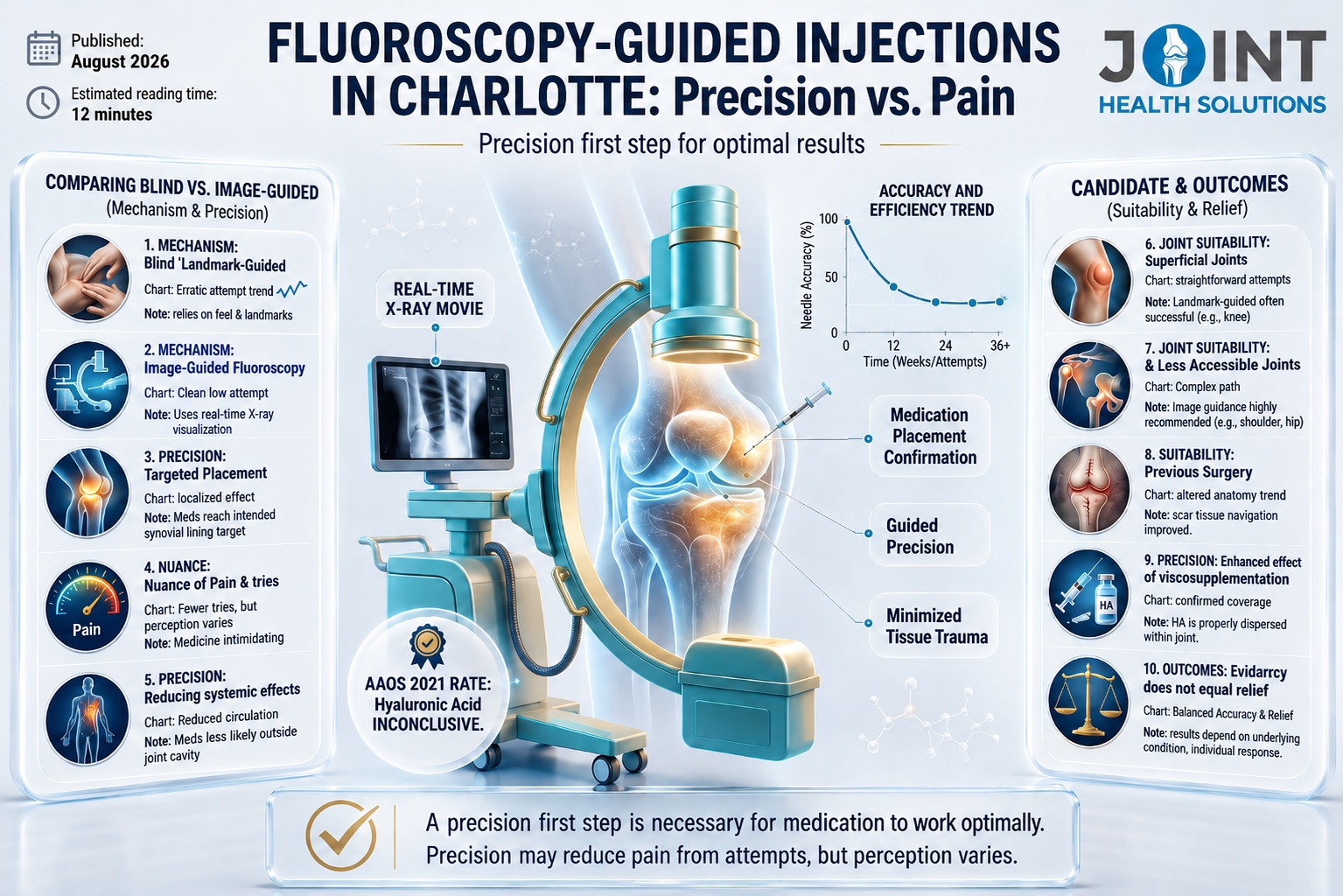
Fluoroscopy is a type of medical imaging that uses a continuous X-ray beam to create real-time moving images of the inside of the body. Think of it as an X-ray “movie” rather than a single snapshot. During a fluoroscopy-guided injection, a specialized machine called a C-arm (because of its C-shaped arm) is positioned over the joint being treated. The provider watches a monitor that displays the joint and the needle as it moves, allowing them to guide the needle tip precisely into the joint space.
The procedure is commonly used for joints that can be difficult to access without imaging, such as the shoulder, or for joints with prior surgery or unusual anatomy. The real-time imaging helps the provider confirm that the needle is in the correct location before injecting medication, which may include a corticosteroid to reduce inflammation, hyaluronic acid to lubricate the joint, or a contrast agent to verify placement.
At Joint Health Solutions in Charlotte, fluoroscopy-guided injections are offered as part of a comprehensive non-surgical approach to joint pain. The clinic uses this technology for various injections, including cortisone and hyaluronic acid, to enhance accuracy and patient comfort. If you’re interested in learning more about the range of treatments and services available, you can explore our treatments and services.
How Fluoroscopy Works in a Joint Injection
The process begins with the patient positioned on an examination table, often lying on their side or back, depending on the joint. The skin over the injection site is cleaned with an antiseptic solution. The provider may apply a local anesthetic to numb the skin and deeper tissues, though some patients prefer to skip this to avoid an extra needle stick.
Using the fluoroscopy machine, the provider identifies the joint space on the monitor. They then insert the needle while watching its progress in real time. For some joints, a small amount of contrast dye is injected first to confirm that the needle is inside the joint capsule. This dye appears bright on the fluoroscopy image, providing a clear visual confirmation. Once placement is confirmed, the medication is injected slowly.
The entire procedure typically takes 10 to 15 minutes, though the actual injection time is often just a few minutes. The real-time imaging allows the provider to adjust the needle angle and depth with precision, potentially reducing the need for multiple needle passes.
How Blind Injections Differ: The Traditional Approach
Blind injections—also called landmark-guided injections—are the traditional method used for many joint injections. In this approach, the provider relies on external anatomical landmarks, palpation (feeling the bones and soft tissues), and their own experience to estimate where the joint space is located. The needle is inserted based on these external cues, without the aid of imaging.
This method is quick and does not require specialized equipment, making it more accessible and less expensive. It is commonly used for joints that are relatively superficial and easy to access, such as the knee. For many patients, a blind injection into the knee is successful and provides relief. However, the accuracy of blind injections can vary significantly depending on the joint and the provider’s skill.
Research has shown that blind injections often miss the target joint space. For example, studies have found that up to one-third of blind knee injections may be placed outside the joint, and for less accessible or previously operated joints, the miss rate can be even higher. When medication is injected outside the joint, it may be less effective and can potentially cause irritation to surrounding tissues, such as tendons or ligaments.
Blind injections also carry a higher risk of multiple needle attempts. Each repositioning of the needle can increase discomfort and the risk of bleeding or bruising. For patients who are anxious about needles, this can be a significant drawback.
Despite these limitations, blind injections remain a common practice because they are convenient and often effective for certain joints. However, for patients who have not found relief with blind injections, or who have complex anatomy, fluoroscopy-guided injections may offer a more precise alternative.
The Role of Imaging in Injection Accuracy
Accuracy is the primary advantage of fluoroscopy-guided injections. By visualizing the joint in real time, the provider can ensure that the needle tip is exactly where it needs to be before delivering the medication. This is especially important for joints that are less accessible or have irregular anatomy, such as a shoulder that has had prior surgery.
Precise placement matters for several reasons. First, it ensures that the medication reaches the intended target, such as the inflamed synovial lining or the cartilage surface. This maximizes the potential for therapeutic benefit. Second, it reduces the risk of injecting medication into surrounding tissues, which can cause pain, tissue irritation, or systemic side effects. Third, it allows the provider to confirm that the medication is distributed within the joint space, which is particularly important for viscosupplementation with hyaluronic acid.
Fluoroscopy also enables the use of contrast dye, which can help identify whether the needle is truly inside the joint. The dye spreads within the joint space, confirming correct placement. This is a level of verification that is impossible with blind injections.
For patients who have had prior joint surgery, such as a knee replacement or shoulder repair, scar tissue and altered anatomy can make blind injections even more challenging. Fluoroscopy can help navigate these complexities, improving the likelihood of a successful injection.
While fluoroscopy-guided injections are more accurate, it’s important to note that accuracy does not guarantee pain relief. The effectiveness of the injected medication depends on the underlying condition and the individual patient. However, accurate placement is a necessary first step for the medication to work optimally.
Pain Perception: Does Precision Reduce Discomfort?
One of the most common questions patients ask is whether fluoroscopy-guided injections are less painful than blind injections. The answer is nuanced. Pain during a joint injection comes from several sources: the needle piercing the skin, the needle passing through deeper tissues, the pressure of the injected fluid, and the number of needle passes.
Fluoroscopy-guided injections may reduce pain in a few ways. First, by visualizing the needle path, the provider can avoid sensitive structures such as nerves, blood vessels, and tendons. This can reduce the sharp, shooting pain that sometimes occurs when a needle touches a nerve. Second, accurate placement means fewer needle repositioning attempts. Each time the needle is pulled back and redirected, it causes additional tissue trauma and pain. With real-time imaging, the provider can guide the needle smoothly to the target, potentially reducing the number of attempts.
Third, the use of local anesthesia is common in fluoroscopy-guided procedures. The provider may numb the skin and deeper tissues before inserting the injection needle, which can significantly reduce discomfort. However, the numbing injection itself can be briefly painful.
On the other hand, some patients find the fluoroscopy machine intimidating or feel discomfort from the positioning required to obtain clear images. The procedure may take slightly longer than a blind injection, which can be a drawback for those who prefer a quick in-and-out experience.
Ultimately, pain perception is subjective and varies from person to person. Some patients report that fluoroscopy-guided injections are more comfortable because of the precision, while others notice little difference. It’s also worth noting that the pain experienced during the injection is usually brief, and any soreness afterward is typically mild.
If you’re concerned about pain, discuss your options with your provider. They may be able to recommend strategies to minimize discomfort, such as using a topical anesthetic or a smaller-gauge needle.
Comparing Outcomes: Accuracy, Efficacy, and Safety
When choosing between fluoroscopy-guided and blind injections, it’s helpful to compare them across several dimensions: accuracy, efficacy, and safety.
Accuracy: As discussed, fluoroscopy-guided injections offer superior accuracy. Studies have demonstrated that image-guided injections have a significantly higher rate of correct needle placement compared to blind injections in general.
Efficacy: Does higher accuracy translate to better clinical outcomes? The evidence is mixed. Some studies suggest that accurate placement leads to improved pain relief and functional outcomes, particularly for knee osteoarthritis. However, other studies have found no significant difference in outcomes between image-guided and blind injections, possibly because the medication can diffuse to nearby tissues even if not perfectly placed.
For hyaluronic acid injections, which are designed to lubricate the joint, accurate placement within the joint space is likely more critical. If the HA is injected outside the joint, it may not provide the desired benefit. However, the AAOS 2021 guideline rates HA injections as Inconclusive overall, meaning the evidence is insufficient to recommend for or against their use.
Safety: Both methods are generally safe when performed by experienced providers. The main risks include infection, bleeding, and tissue irritation. Fluoroscopy-guided injections may reduce the risk of injecting into a tendon or nerve, which can cause serious complications. However, fluoroscopy exposes the patient to a small amount of ionizing radiation, though the dose is typically low and considered safe for most patients.
Overall, the choice between fluoroscopy-guided and blind injections depends on the joint, the patient’s anatomy, and the provider’s expertise. For joints that are less accessible, or for patients who have had unsuccessful blind injections, fluoroscopy-guided injections may offer advantages.
Here is a comparison table to summarize the key differences:
| Treatment | How It Works | Limitations | Risks |
|---|---|---|---|
| Blind (landmark-guided) injection | Provider uses anatomical landmarks and palpation to guide the needle | Higher risk of inaccurate placement, especially for less accessible joints; may require multiple attempts | Injection into surrounding tissues, nerve irritation, bruising, infection |
| Fluoroscopy-guided injection | Real-time X-ray imaging to visualize the joint and needle | Requires specialized equipment and training; small radiation exposure; slightly longer procedure | Radiation exposure (low dose), infection, bleeding, contrast dye allergy (rare) |
It’s important to note that the evidence for the superiority of fluoroscopy-guided injections in terms of pain relief is not conclusive. More research is needed to determine which patients benefit most from this approach.
What to Expect During a Fluoroscopy-Guided Procedure
If you’re scheduled for a fluoroscopy-guided injection at Joint Health Solutions in Charlotte, here’s what you can expect.
Before the procedure, you’ll have a consultation with one of our providers to review your medical history and confirm that the injection is appropriate. You may be asked to stop taking certain blood-thinning medications before the injection to reduce bleeding risk.
On the day of the procedure, you’ll be positioned on an examination table. The area around the joint will be cleaned with an antiseptic. A local anesthetic may be applied to numb the skin and deeper tissues. The fluoroscopy machine will be positioned to obtain a clear view of the joint.
The provider will insert the needle while watching the fluoroscopy monitor. You may feel some pressure or mild discomfort, but it should be less than you might expect. Once the needle is in place, the medication is injected slowly. You may feel a sense of fullness or pressure as the fluid enters the joint.
The entire procedure typically takes 15 to 30 minutes, including preparation and imaging. After the injection, you’ll be observed briefly to ensure there are no immediate complications, and then you can go home.
Our team at Joint Health Solutions is experienced in performing fluoroscopy-guided injections. If you’d like to learn more about our providers, you can visit our providers page.
Recovery and Aftercare: Minimizing Injection Site Pain
After a fluoroscopy-guided injection, you may experience some soreness at the injection site. This is normal and typically resolves within a few days. To minimize discomfort, you can apply ice to the area for 15-20 minutes at a time, several times a day. Over-the-counter pain relievers, such as acetaminophen, may also help, but you should avoid non-steroidal anti-inflammatory drugs (NSAIDs) like ibuprofen for a few days if you received a corticosteroid injection, as they may interfere with the steroid’s effect.
It’s important to give the joint some rest for the first 24-48 hours. Avoid strenuous activities or heavy lifting. You can gradually resume normal activities as your pain allows. If you received a hyaluronic acid injection, it may take a few days to a week for the full effect to develop.
You should contact your provider if you experience signs of infection, such as increased redness, swelling, warmth, or fever, or if you have severe pain that doesn’t improve.
Recovery timelines depend on the medication injected: corticosteroid injections often bring noticeable relief within a few days, while hyaluronic acid injections may take longer to build effect. Some patients may require a series of injections to achieve optimal relief.
Are You a Candidate for Image-Guided Injections?
Not everyone is a candidate for fluoroscopy-guided injections. The decision depends on the joint being treated, your overall health, and your specific condition.
Fluoroscopy-guided injections are particularly beneficial for:
- The shoulder, or other joints that can be harder to access without imaging
- Patients who have had previous joint surgery, which may alter anatomy
- Patients who have not responded to blind injections
- Patients where anatomical landmarks are difficult to palpate
- Joints that require a high degree of accuracy, such as when injecting hyaluronic acid
However, fluoroscopy-guided injections may not be necessary for everyone. For example, a straightforward knee injection in a thin patient may be successfully performed with a blind technique. Your provider will discuss the pros and cons with you and recommend the most appropriate approach.
At Joint Health Solutions, we offer both blind and fluoroscopy-guided injections, depending on your needs. Our goal is to provide the safest, most effective treatment possible. If you’re unsure whether image-guided injections are right for you, we encourage you to schedule a consultation.
Evidence on Accuracy and Outcomes
The evidence supporting fluoroscopy-guided injections is strongest for accuracy. Systematic reviews of image-guided joint injections have found that fluoroscopy-guided injections generally achieve a significantly higher accuracy rate compared to landmark-guided injections. However, the clinical significance of this improved accuracy is less clear, as some studies showed better pain relief while others did not.
For knee injections, the evidence is more mixed. Studies comparing ultrasound-guided and blind knee injections have found that image-guided injections were more accurate, but there was not always a significant difference in pain relief at 6 weeks. Similar findings have been reported for fluoroscopy-guided knee injections.
It’s also important to consider that fluoroscopy involves radiation exposure, albeit at low doses. The risk of radiation-induced complications from a single fluoroscopy-guided injection is considered very low, but it is not zero. This is especially relevant for patients who require multiple injections over time.
Overall, the decision to use fluoroscopy-guided injections should be individualized. Your provider can help you weigh the potential benefits of improved accuracy against the considerations involved.
Evidence Table
| Evidence Level | What It Shows |
|---|---|
| Established clinical evidence | Fluoroscopy-guided injections improve needle placement accuracy compared to blind injections. |
| Limited human evidence | Some studies suggest improved pain relief with image-guided injections, but results are inconsistent. |
| Mixed evidence | Clinical outcomes (pain, function) do not consistently differ between image-guided and blind injections. |
| Mechanistic / emerging evidence | Accurate placement may enhance the effect of viscosupplementation by ensuring medication is within the joint space. |
| Investigational | Ongoing research is evaluating the cost-effectiveness and long-term outcomes of routine fluoroscopy use. |
Key Takeaways: Making an Informed Choice
- Fluoroscopy-guided injections use real-time X-ray to improve needle placement accuracy.
- Blind injections rely on anatomical landmarks and may be less accurate for less accessible joints.
- Precision may reduce pain from multiple needle attempts, but pain perception varies.
- Evidence shows improved accuracy, but clinical outcomes are mixed.
- Talk to your provider about whether image guidance is right for your specific joint condition.
Schedule a Consultation in Charlotte
If you’re considering a joint injection and want to explore whether fluoroscopy-guided injections in Charlotte are right for you, the team at Joint Health Solutions is here to help. We offer a range of non-surgical treatments — explore our full treatments and services to learn more about our approach. Our experienced providers can discuss your symptoms, review imaging, and recommend a personalized treatment plan. Call us at 704-833-3566 to schedule a consultation. We also invite you to read our reviews from other Charlotte patients.
Institutional Sources
- AAOS: Clinical Practice Guideline on Treatment of Osteoarthritis of the Knee
- Mayo Clinic: Joint Injection (Cortisone Shots)
- NIAMS: Osteoarthritis
- Arthritis Foundation: Injections for Osteoarthritis
Frequently Asked Questions
How long does a fluoroscopy-guided injection take?
The procedure itself typically takes 10 to 15 minutes, but you should allow 30-45 minutes for preparation and recovery. The actual injection time is usually just a few minutes.
What does a fluoroscopy-guided injection cost?
Joint Health Solutions operates on a self-pay basis with transparent, upfront pricing. Cost depends on the joint being treated and the medication used. Our team can provide a quote during your consultation.
What is the success rate of fluoroscopy-guided injections?
The success rate depends on the condition being treated and the specific joint. For accuracy, fluoroscopy-guided injections have a high success rate in placing the needle correctly. For pain relief, success rates vary; results depend on the individual and the underlying condition.
Are there any risks associated with fluoroscopy-guided injections?
Risks include a small amount of radiation exposure, infection, bleeding, and allergic reaction to contrast dye (rare). The radiation dose is low, and the benefits of improved accuracy often outweigh the risks.
Will I feel pain during the injection?
You may feel some pressure or mild discomfort, but local anesthesia is often used to minimize pain. The procedure is generally well-tolerated.
How soon will I feel relief after a fluoroscopy-guided injection?
Relief may be noticeable within a few days for some patients, especially with corticosteroids, but it can take longer for the full effect. For hyaluronic acid injections, it may take up to a week or more.
Can fluoroscopy-guided injections be used for any joint?
Yes, fluoroscopy can be used for most joints, but it is most beneficial for joints that are harder to access or have altered anatomy, such as the shoulder or a joint with prior surgery.
How many injections will I need?
The number of injections depends on your condition. Some patients need only one, while others may require a series of injections over several weeks.
What is the difference between fluoroscopy and ultrasound guidance?
Fluoroscopy uses X-rays to see bones and joints, while ultrasound uses sound waves to see soft tissues. Ultrasound does not involve radiation and can visualize tendons and ligaments, but fluoroscopy provides a better view of bone structures.
Are fluoroscopy-guided injections more expensive than blind injections?
Yes, they are typically more expensive due to the use of imaging equipment and additional time. However, the potential for fewer repeat injections may offset the cost. Our team can walk you through pricing during your consultation.




 English
  Spanish