

Anti-Inflammatory IV Therapy: Boost Recovery After Joint Injections
Joint pain can feel like a constant weight, limiting your ability to move, work, and enjoy life. If you have received a joint injection—whether a corticosteroid to reduce acute inflammation or a viscosupplementation injection to improve lubrication—you may be wondering what else you can do to support your recovery. Anti-inflammatory IV therapy has gained attention as an adjunctive approach that may help your body respond more effectively to these treatments. This article explores how this therapy works, what it can and cannot do, and how it fits into a comprehensive non-surgical joint care plan at Joint Health Solutions in Charlotte, North Carolina.
Joint injections are a cornerstone of non-surgical orthopedic care. They deliver medication directly to the affected joint, providing targeted relief that oral medications often cannot achieve. However, the success of any injection depends on your body’s ability to heal and manage inflammation. Systemic inflammation can undermine the benefits of a local injection, which is where anti-inflammatory IV therapy may play a supporting role. By delivering a blend of fluids, electrolytes, vitamins, and antioxidants directly into your bloodstream, this therapy aims to create a more favorable environment for healing.
It is important to understand that IV therapy is not a miracle cure. It does not replace joint injections, physical therapy, or lifestyle changes. Instead, it may serve as a complementary strategy that some patients find helpful during their recovery journey. In this article, we will examine the science behind IV therapy, its potential benefits, and how to determine if it is right for you.
Understanding Anti-Inflammatory IV Therapy
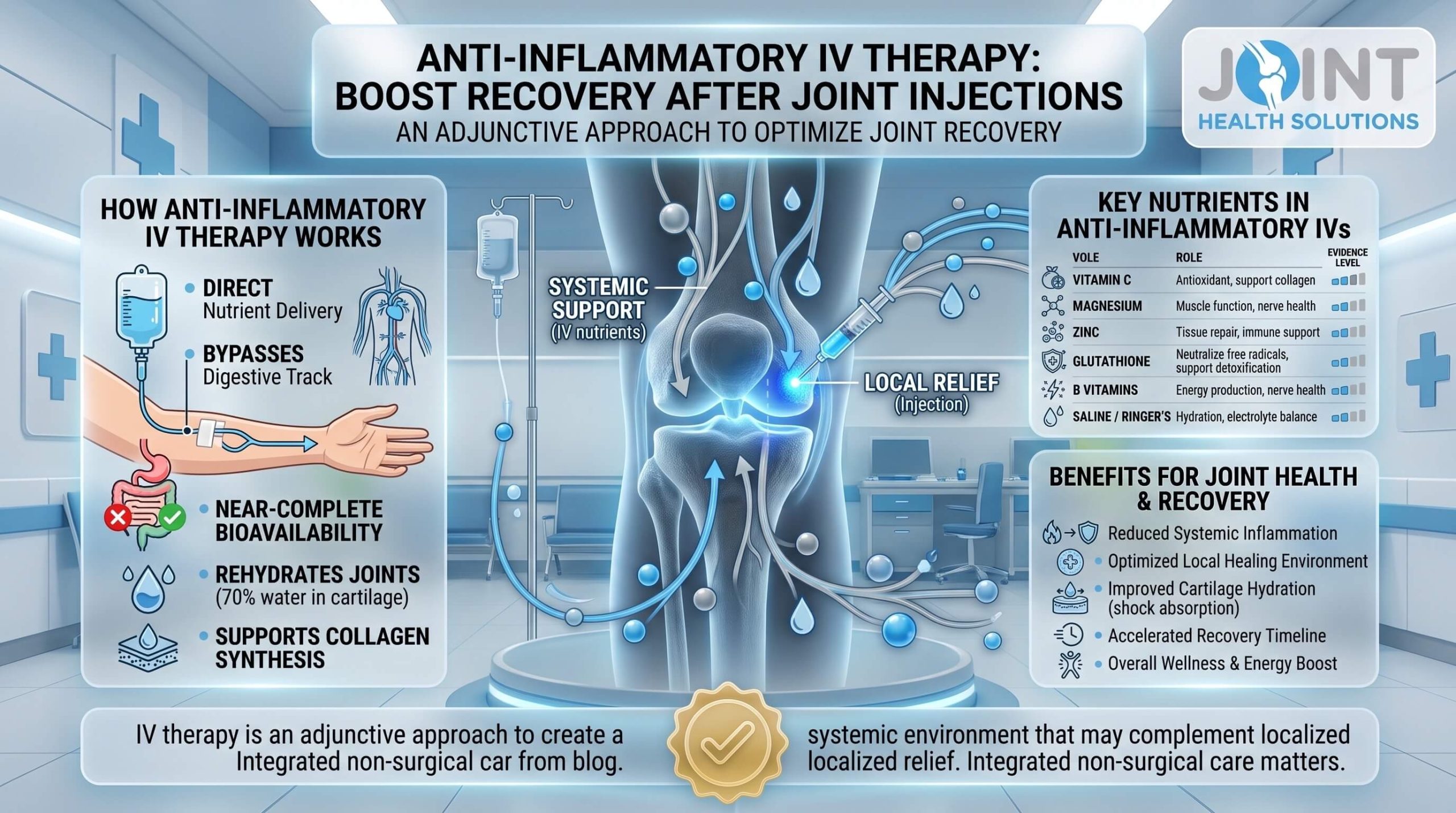
Anti-inflammatory IV therapy is a treatment that delivers a customized blend of fluids, electrolytes, vitamins, and antioxidants directly into the bloodstream through an intravenous line. Unlike oral supplements, which must pass through the digestive system, IV therapy bypasses the gastrointestinal tract, allowing for near-complete bioavailability of the nutrients. This means that the body can immediately use the delivered substances, which may be beneficial for individuals seeking rapid support for inflammation and recovery.
The concept is not new. IV therapy has been used in hospitals for decades to rehydrate patients, correct electrolyte imbalances, and deliver medications. In recent years, outpatient wellness clinics have adapted this approach to address a variety of concerns, including fatigue, immune support, and, notably, joint pain. For joint health, the goal is to reduce systemic inflammation, which may complement the effects of local injections.
It is essential to clarify that IV therapy is not a substitute for evidence-based treatments like joint injections. Rather, it is an adjunctive therapy that may help some patients. The evidence supporting IV therapy for joint recovery is still emerging, and results vary from person to person. At Joint Health Solutions, we view IV therapy as one tool in a broader non-surgical treatment plan.
The Role of Inflammation in Joint Pain
Inflammation is a natural immune response that helps the body fight infection and repair tissue. However, when inflammation becomes chronic, it can contribute to joint pain, stiffness, and swelling. Conditions like osteoarthritis and post-injury inflammation involve complex inflammatory pathways that can affect the entire body, not just the joint itself.
Systemic inflammation can be influenced by diet, stress, sleep, and other factors. When your body is in a pro-inflammatory state, even a well-placed joint injection may not achieve its full effect. This is where anti-inflammatory IV therapy may offer an advantage. By delivering antioxidants like vitamin C and glutathione, which are known to neutralize free radicals, IV therapy may help reduce oxidative stress and support the body’s natural anti-inflammatory processes.
It is important to note that local inflammation is not always harmful. In fact, some degree of inflammation is necessary for healing after an injection. The goal is not to eliminate inflammation entirely but to modulate it so that it does not interfere with recovery. Anti-inflammatory IV therapy aims to create a balance, supporting the healing response without suppressing it completely.
How IV Therapy Complements Joint Injections
Joint injections work by delivering medication directly to the source of pain. Corticosteroid injections, for example, are potent anti-inflammatories that can reduce swelling and pain in the joint. Hyaluronic acid injections, also known as viscosupplementation, aim to restore the lubricating properties of synovial fluid. While these injections are effective for many patients, their benefits can be enhanced by addressing systemic factors.
Anti-inflammatory IV therapy may complement joint injections in several ways:
- Hydration: Proper hydration is essential for joint health. The cartilage in your joints is about 70% water, and dehydration can impair its ability to absorb shock. IV therapy delivers fluids directly into the bloodstream, ensuring that your joints have the hydration they need.
- Nutrient support: Vitamins and minerals like vitamin C, magnesium, and zinc play roles in collagen synthesis and tissue repair. By delivering these nutrients intravenously, the therapy may support the healing process.
- Reducing systemic inflammation: By providing antioxidants and anti-inflammatory compounds, IV therapy may help lower overall inflammation, potentially amplifying the local effects of the injection.
- Promoting relaxation: Many patients find the IV therapy session itself to be calming, which can reduce stress-related inflammation.
It is crucial to understand that IV therapy is not a replacement for joint injections. Instead, it may be used before or after an injection to optimize the body’s response. For example, some patients choose to have an IV session a few days before their injection to ensure they are well-hydrated and their nutrient levels are adequate. Others may schedule IV therapy after the injection to support recovery.
Key Nutrients and Ingredients in Anti-Inflammatory IVs
The exact composition of an anti-inflammatory IV varies depending on the clinic and the patient’s needs. However, several ingredients are commonly used for their potential anti-inflammatory and recovery-supporting properties:
| Ingredient | Potential Role | Evidence Level |
|---|---|---|
| Vitamin C | Antioxidant that may reduce oxidative stress and support collagen production | Limited human evidence |
| Magnesium | Involved in muscle relaxation and nerve function; may help reduce cramps | Limited human evidence |
| Zinc | Supports immune function and tissue repair | Mechanistic / emerging evidence |
| Glutathione | Antioxidant that helps neutralize free radicals | Mechanistic / emerging evidence |
| B vitamins | Essential for energy production and nerve health | Established clinical evidence for deficiency correction |
| Normal saline or lactated Ringer’s | Provides hydration and electrolyte balance | Established clinical evidence |
It is important to note that while these ingredients have theoretical benefits, the evidence for IV therapy specifically for joint recovery is still in its infancy. Most studies have been small or focused on other conditions. Therefore, it is essential to approach IV therapy with realistic expectations.
What to Expect During an IV Therapy Session
If you have never received IV therapy, you might wonder what the experience entails. At Joint Health Solutions, we strive to make the process comfortable and stress-free. Here is a general overview of what you can expect:
- Consultation: Before your first session, you will meet with a provider to discuss your medical history, current medications, and goals. This ensures that the IV formulation is tailored to your needs.
- Preparation: You will be seated in a comfortable chair, and a nurse will clean the injection site, usually on your arm or hand.
- Insertion: A small needle is inserted into a vein, and a thin catheter is left in place. Most patients feel only a brief pinch.
- Infusion: The IV solution is administered over 30 to 60 minutes, depending on the volume and ingredients. You can relax, read, or use your phone during this time.
- Monitoring: A healthcare professional will monitor you for any adverse reactions. Common side effects are mild and may include a cool feeling at the site or a slight metallic taste.
- Aftercare: Once the infusion is complete, the catheter is removed, and you can resume normal activities. Some patients feel a boost of energy, while others feel relaxed.
The number of sessions you might need depends on your condition and response. Some patients benefit from a single session, while others may schedule a series of weekly or monthly infusions. Your provider will recommend a plan based on your individual situation.
Potential Benefits for Joint Health and Recovery
While research is ongoing, patients and practitioners have reported several potential benefits of anti-inflammatory IV therapy for joint health:
- Reduced pain and stiffness: By lowering systemic inflammation, IV therapy may help reduce joint pain and improve mobility.
- Faster recovery: Some patients feel that IV therapy helps them bounce back more quickly after a joint injection or other procedure.
- Improved hydration: Proper hydration is essential for joint lubrication and nutrient transport.
- Enhanced nutrient absorption: Because IV therapy bypasses the digestive system, it ensures that nutrients are delivered directly to cells.
- Overall well-being: Many patients report feeling more energetic and less fatigued after a session.
It is crucial to emphasize that these benefits are not guaranteed. Individual responses vary, and IV therapy is not a cure for arthritis or other joint conditions. It is best used as part of a comprehensive treatment plan that includes joint injections, physical therapy, and lifestyle modifications.
Comparing IV Therapy with Oral Anti-Inflammatories
Many patients wonder how IV therapy compares to taking oral anti-inflammatory medications, such as ibuprofen or naproxen. Both approaches aim to reduce inflammation, but they differ in several ways:
| Treatment | How It Works | Limitations | Risks |
|---|---|---|---|
| Oral NSAIDs | Block inflammatory enzymes after being absorbed through the digestive tract | Can cause stomach irritation, kidney issues, and cardiovascular risks with long-term use | GI bleeding, ulcers, increased blood pressure |
| Anti-inflammatory IV therapy | Delivers fluids, vitamins, and antioxidants directly into the bloodstream | Requires a healthcare professional; self-pay service; evidence is limited | Infection, bruising, allergic reaction (rare) |
It is important to note that IV therapy is not a replacement for oral medications that have been prescribed by your doctor. For acute pain, oral NSAIDs may be more appropriate and are supported by extensive clinical evidence. IV therapy should be viewed as an adjunctive option, not a substitute.
Who Can Benefit from Anti-Inflammatory IV Therapy?
Anti-inflammatory IV therapy may be suitable for individuals who:
- Have received a joint injection and want to optimize their recovery.
- Experience chronic joint pain and are looking for complementary approaches.
- Have difficulty tolerating oral anti-inflammatory medications due to stomach issues.
- Are interested in a proactive approach to joint health and overall wellness.
- Are athletes or active individuals seeking faster recovery after intense training or sports injuries, as part of sports recovery IV therapy.
However, not everyone is a candidate. IV therapy may not be safe for individuals with certain medical conditions, such as kidney disease, heart failure, or fluid overload. Pregnant or breastfeeding women should consult their healthcare provider before undergoing IV therapy. At Joint Health Solutions, we conduct a thorough screening to determine if IV therapy is appropriate for you.
Safety and Side Effects: What You Should Know
IV therapy is generally considered safe when administered by trained healthcare professionals. The most common side effects are mild and include:
- Bruising or soreness at the injection site
- A cool sensation during the infusion
- A metallic taste in the mouth
- Redness or swelling at the site
Serious complications are rare but can include infection, air embolism, or allergic reactions. To minimize risks, it is essential to receive IV therapy at a reputable clinic with proper protocols. At Joint Health Solutions, our medical team follows strict safety guidelines to ensure your well-being.
It is also important to note that IV therapy is not regulated by the FDA in the same way as prescription drugs. The ingredients used are generally recognized as safe, but the therapy itself is not approved for any specific medical condition. This is why it is crucial to have a thorough consultation before starting treatment.
Integrating IV Therapy into Your Joint Care Plan
If you are considering anti-inflammatory IV therapy, it is essential to integrate it into a comprehensive joint care plan. At Joint Health Solutions, we offer a range of non-surgical treatments, including joint injections, physical therapy, and nutritional counseling. IV therapy may be used as an adjunct to these services to support your overall recovery.
Here are some steps to consider:
- Schedule a consultation with a provider to discuss your joint pain and treatment goals.
- Undergo a thorough evaluation, including imaging if necessary, to determine the underlying cause of your pain.
- Discuss whether IV therapy is appropriate for you and what formulation would be most beneficial.
- Combine IV therapy with other evidence-based treatments, such as joint injections or physical therapy.
- Monitor your progress and adjust your plan as needed.
Remember, IV therapy is not a standalone solution. It works best when combined with a holistic approach to joint health, including a balanced diet, regular exercise, and stress management.
If you have received or are considering hyaluronic acid injections, it is important to understand that the AAOS rates the evidence as inconclusive, and results vary. This is where anti-inflammatory IV therapy may play a supportive role, helping to create a systemic environment that may enhance the injection’s effects. However, more research is needed to confirm this benefit.
Take the Next Step for Your Joint Health
If you are interested in learning more about how anti-inflammatory IV therapy might fit into your joint recovery plan, we invite you to schedule a consultation with our specialists at Joint Health Solutions in Charlotte, North Carolina. Our team, including Dr. Jeffrey Galvin and Ariel Curtis, FNP-C, will evaluate your condition and create a personalized treatment plan that may include joint injections, physical therapy, and IV therapy. Explore our full treatments and services, or call us today at 704-833-3566 to discover if this therapy is right for you. Your journey to better joint health starts here.
Institutional Sources
- AAOS Clinical Practice Guideline on Treatment of Osteoarthritis of the Knee
- Mayo Clinic – Intravenous Therapy (IV)
- Arthritis Foundation – Inflammation and Joint Pain
- National Institute of Arthritis and Musculoskeletal and Skin Diseases – Osteoarthritis
Frequently Asked Questions
How often should I get anti-inflammatory IV therapy?
The frequency of IV therapy sessions depends on your individual needs and response. Some patients benefit from a single session, while others may schedule weekly or monthly infusions. Your provider will recommend a plan based on your condition and treatment goals.
Can IV therapy replace joint injections?
No, IV therapy is not a replacement for joint injections. It is an adjunctive therapy that may support recovery by reducing systemic inflammation and improving hydration. Joint injections deliver medication directly to the joint, which is a different mechanism of action.
Are there any side effects of anti-inflammatory IV therapy?
Most side effects are mild and include bruising at the injection site, a cool sensation, or a metallic taste. Serious complications are rare but can include infection or allergic reactions. It is important to receive IV therapy from a qualified provider.
How long does it take to feel the benefits?
Some patients notice hydration and energy benefits shortly after their infusion, while any effect on joint-related inflammation tends to build more gradually over subsequent sessions. Response depends on your baseline hydration and nutrient status, the condition being addressed, and how many sessions you complete.
What does anti-inflammatory IV therapy cost, and are payment options available?
Joint Health Solutions operates on a self-pay basis for IV therapy, with transparent, upfront pricing. Some patients ask about package pricing for multiple sessions. Our team can walk you through cost and payment options during your consultation.
Can I have IV therapy if I have kidney disease?
IV therapy may not be safe for individuals with kidney disease or heart failure, as it can cause fluid overload. A thorough medical screening is necessary before starting IV therapy. Always consult your primary care physician.
What is the difference between IV therapy and a vitamin shot?
IV therapy delivers a larger volume of fluids and nutrients directly into the bloodstream, allowing for near-complete bioavailability. A vitamin shot, such as a B12 injection, delivers a smaller dose into the muscle or fat, which is absorbed more slowly.
Can IV therapy help with arthritis?
IV therapy may help reduce systemic inflammation, which could provide some relief for arthritis symptoms. However, it is not a cure and should be used as part of a comprehensive treatment plan. Evidence is limited, and results vary.
Do I need to fast before IV therapy?
No, fasting is not required. In fact, it is recommended to be well-hydrated and to have eaten a light meal before your session to prevent dizziness.
Can IV therapy be combined with other treatments?
Yes, IV therapy can be combined with joint injections, physical therapy, and other non-surgical treatments. At Joint Health Solutions, we often recommend IV therapy as an adjunct to our other services to optimize recovery.




 English
  Spanish