
Knee arthritis can make walking, climbing stairs, standing, exercising, working, and completing everyday activities more difficult. Adults searching for Knee Arthritis Treatment Concord NC can visit Joint Health Solutions for symptom-led evaluation and personalized non-surgical care planning.
Patients from Concord and Cabarrus County are seen at the Joint Health Solutions clinic at 9350 Benfield Rd, #109, Charlotte, NC 28269. The practice does not currently operate a physical clinic in Concord.
Treatment begins by understanding your symptoms, knee function, previous care, medical history, and mobility goals. Depending on the findings, an appropriate plan can include education, physical therapy, activity modification, knee bracing, weight or nutrition support, joint aspiration, selected injections, or orthopedic referral.
Knee arthritis cannot currently be reversed, but many patients can explore nonsurgical strategies designed to support comfort, strength, movement, and daily function. Treatment suitability and response vary, and no procedure can guarantee cartilage regrowth, permanent relief, or avoidance of knee replacement.
Care is led by experienced medical professionals, including Dr. Jeffrey Galvin and Ariel Curtis, FNP-C.
Knee arthritis refers to conditions that cause inflammation, structural change, and reduced function within the knee joint. Osteoarthritis is the most common form and involves changes in cartilage, bone, the joint lining, and surrounding tissues.
Cartilage normally creates a smooth surface that helps the bones move with less friction. As osteoarthritis develops, cartilage and other joint tissues can change, leading to pain, stiffness, swelling, grinding, and reduced movement.
Knee arthritis is more complex than simple “wear and tear.” Factors that can contribute include:
Symptoms do not always match the amount of arthritis visible on an imaging study. Some patients have substantial structural changes with manageable symptoms, while others experience meaningful pain and functional limitations.

The knee includes three main compartments. Arthritis can affect one compartment, multiple compartments, or the entire joint.

The medial compartment is the inner portion of the knee between the thighbone and shinbone.
Arthritis in this area can contribute to:
A properly selected offloading brace can be considered when arthritis predominantly affects one knee compartment.

The lateral compartment is the outer portion of the knee.
Symptoms can include:
Lateral-compartment symptoms can overlap with other knee conditions, so pain location alone does not confirm arthritis.

The patellofemoral joint is where the kneecap moves over the front of the thighbone.
Patellofemoral arthritis can cause:
Understanding which compartments appear involved can help guide rehabilitation, bracing, activity recommendations, and procedure discussions.
| Symptom | What It Can Feel Like |
|---|---|
| Pain | Aching or soreness during walking, stairs, standing, bending, or activity. More advanced symptoms can also occur during rest. |
| Stiffness | Difficulty moving after sleep, sitting, driving, or another period of inactivity. |
| Swelling | Recurring fullness, puffiness, or fluid buildup around the knee. |
| Crepitus | Grinding, cracking, or popping during movement. Joint sounds alone do not confirm painful arthritis. |
| Reduced Range of Motion | Difficulty fully bending or straightening the knee. |
| Instability | A feeling that the knee is weak, unreliable, or could give way. |
| Alignment Changes | A gradual bowleg or knock-knee appearance in more advanced disease. |
| Functional Limitations | Difficulty walking, using stairs, standing, exercising, working, or completing household activities. |
Knee arthritis should be evaluated when symptoms persist, repeatedly return, worsen, or begin limiting daily activities.
Seek prompt medical care for sudden severe swelling, fever with a hot or red knee, deformity after an injury, inability to bear weight, a physically locked knee, new calf swelling, or rapidly worsening pain. These symptoms can indicate a condition other than routine osteoarthritis.
The appropriate plan begins with understanding how knee symptoms affect movement, activity, work, sleep, and independence.

Your provider can review:

A focused examination can assess:

Bring relevant imaging reports, orthopedic notes, or procedure records when available.
When further imaging, laboratory evaluation, urgent assessment, or specialist consultation is needed, your provider can explain the appropriate next step. Not every patient requires the same diagnostic process.
The evaluation can lead to conservative guidance, physical therapy, bracing, a procedure-specific consultation, additional assessment, or orthopedic referral.
Selected patients can be evaluated for an injection after the diagnosis, symptoms, medical history, earlier treatment, alternatives, risks, and evidence limitations have been reviewed.
Ultrasound or fluoroscopy can be used for selected procedures when clinically appropriate. Not every knee injection requires the same form of guidance, and an injection should not be recommended solely because arthritis is present.
| Treatment Option | Commonly Considered For | Typical Goal | Evidence and Important Limitations |
|---|---|---|---|
| Corticosteroid Injection | Selected osteoarthritis or inflammation-related flare symptoms | Short-term reduction in pain and inflammation | Can provide short-term relief but does not rebuild cartilage or permanently alter arthritis. |
| Hyaluronic Acid Injection | Selected patients with symptomatic knee osteoarthritis | Attempt to support knee comfort and function | Professional recommendations differ. AAOS does not recommend routine use, and individual response varies. |
| PRP Therapy | Selected knee osteoarthritis patients following an evidence and cost discussion | Attempt to improve symptoms and function | AAOS rates the evidence as limited. Protocols vary, and cartilage regeneration is not guaranteed. |
| Toradol IM Injection | Selected acute pain presentations when medically appropriate | Short-term systemic pain support | Injected into a muscle rather than the knee joint. It is not an image-guided knee injection or routine long-term arthritis treatment. Gastrointestinal, kidney, cardiovascular, and bleeding risks require individual medical review. |
For detailed knee procedure information, visit Knee Injections Concord NC
The goal of nonsurgical care is to support function, movement, strength, and symptom management while helping patients make informed decisions about ongoing care.
Physical therapy and therapeutic exercise are central components of knee osteoarthritis care.
A personalized program can support:
Exercise should be adjusted to the patient’s symptoms, fitness level, medical considerations, and tolerance. Temporary muscle soreness can occur when beginning a program, but progressive or severe pain should be reviewed.
Learn more about Physical Therapy
Activity modification does not necessarily mean stopping all movement. It means reducing unnecessary stress while maintaining appropriate activity.
Strategies can include:
Depending on the patient’s function, suitable activities can include walking, stationary cycling, water-based exercise, and provider-approved strengthening.
For appropriate patients with knee osteoarthritis and excess body weight, gradual weight reduction can support pain and function by reducing mechanical demand on the knee.
A sustainable plan can include:
Body weight is not the only cause of knee arthritis, and weight reduction is not necessary or appropriate for every patient.
Learn more about the Nutrition Plan
Selected patients can benefit from a properly fitted knee brace.
An offloading brace is designed to redistribute pressure when arthritis affects one compartment more than another. Suitability depends on:
A brace does not restore cartilage and should not be selected without considering the underlying knee condition.
Learn more about Offloading Knee Braces
Medication decisions should reflect the patient’s medical history, current medications, kidney and gastrointestinal health, cardiovascular risk, allergies, and clinician guidance.
Common categories discussed in knee osteoarthritis care can include topical or oral nonsteroidal anti-inflammatory medications and other non-opioid options. This page does not provide medication doses or instruct patients to start, stop, or change treatment.
Supplements marketed for joint health have mixed evidence and should not be described as proven cartilage-restoration treatments.
Knee arthrocentesis, also called joint aspiration, can be considered when substantial excess fluid creates pressure, swelling, stiffness, or reduced motion.
Aspiration is not required for every swollen knee. It does not correct cartilage damage, and fluid can return when the underlying cause continues.
Learn more about Knee Arthrocentesis
Platelet-rich plasma therapy uses a concentrated preparation made from the patient’s own blood. Platelets contain signaling proteins involved in the body’s normal response to tissue stress.
PRP can be discussed for selected knee osteoarthritis patients after considering:
Symptom severity, Earlier conservative care, Medical history, Treatment goals, Cost and insurance limitations, Differences between PRP protocols, Available evidence, Alternatives.
AAOS states that PRP can potentially reduce pain and improve function in symptomatic knee osteoarthritis, but it rates the supporting evidence as limited.
PRP does not guarantee:
Cartilage regrowth, Reversal of osteoarthritis, Meniscus regeneration, Permanent symptom relief, Prevention of knee replacement, A specific treatment duration.
The decision to use PRP should follow an individualized discussion of possible benefits, uncertainty, risks, cost, and alternatives.
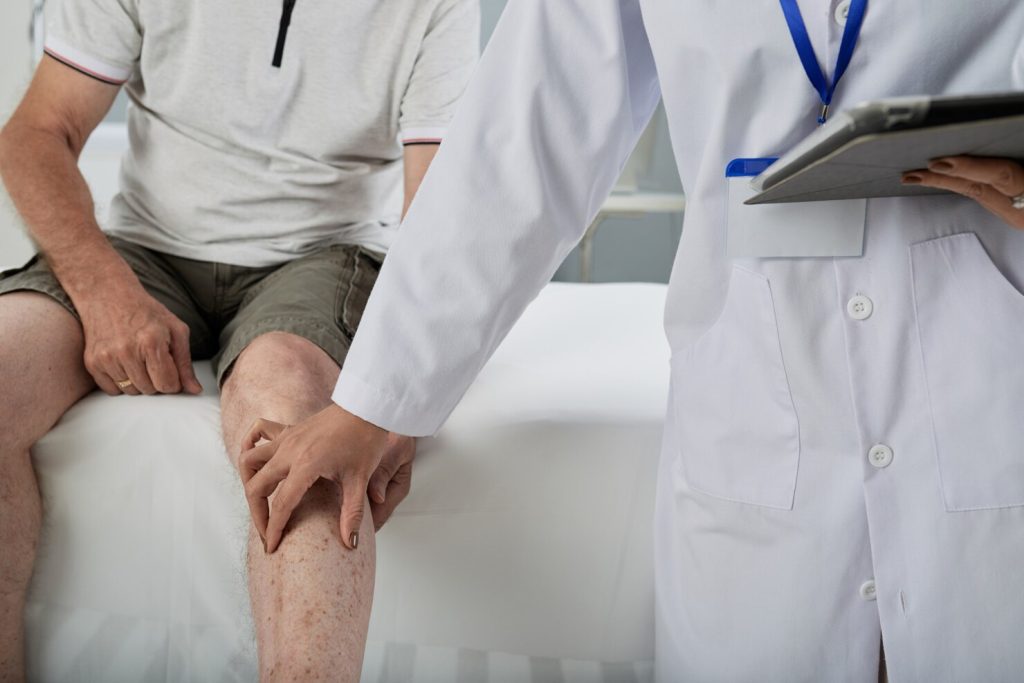

Orthopedic or joint-replacement consultation can be appropriate when knee arthritis causes substantial functional loss or when an appropriate nonsurgical plan no longer provides enough support.
Referral can be considered when there is:
A referral does not mean knee replacement will automatically be recommended. It provides access to further evaluation and a balanced discussion of operative and nonoperative options.
Nonsurgical treatment cannot guarantee that surgery will be delayed, prevented, or permanently unnecessary.
Knee-Focused Evaluation
Care begins by reviewing knee symptoms, functional limitations, previous treatment, and individual goals rather than assigning every patient the same procedure.
Nonsurgical Care Planning
Physical therapy, activity guidance, bracing, aspiration, lifestyle support, and selected procedures can be considered when clinically appropriate.
Evidence-Aware Treatment Discussions
Recommendations distinguish stronger conservative evidence from limited or conflicting injection evidence.
Personalized Care
Treatment planning can reflect arthritis symptoms, compartment involvement, mobility goals, medical considerations, activity level, and previous response.
Provider-Led Care
The care team includes Ariel Curtis, FNP-C, Joint Injection Specialist, and Jeffrey Galvin, MD, Medical Director.
Clear Referral Guidance
Nonsurgical treatment is not presented as the only pathway. Orthopedic evaluation remains appropriate when symptoms, deformity, instability, or functional loss justify it.
Knee pain is a symptom with many possible causes, including arthritis, meniscus problems, tendon irritation, bursitis, ligament injury, or overuse. Knee arthritis is a specific joint condition involving changes in cartilage, bone, the joint lining, and surrounding tissues. Pain, swelling, stiffness, or grinding does not confirm arthritis by itself. A focused evaluation helps determine which condition appears most likely.
Schedule an evaluation when knee pain, stiffness, swelling, instability, or reduced motion persists, repeatedly returns, worsens, or interferes with walking, stairs, standing, work, exercise, or sleep. Prompt assessment is especially important after significant trauma or when symptoms include deformity, inability to bear weight, a locked knee, rapid swelling, or fever with a hot and red joint.
Current treatments do not reverse established knee osteoarthritis or reliably replace lost cartilage. Care generally focuses on supporting movement, strength, function, and symptom management. Physical therapy, activity modification, appropriate weight support, bracing, aspiration, or selected injections can be considered. Improvement in pain or mobility does not necessarily mean that structural joint changes have been reversed.
Many patients begin with nonsurgical care. Depending on symptoms and medical considerations, this can include education, exercise, physical therapy, activity changes, weight support when appropriate, bracing, arthrocentesis, or selected injections. Nonsurgical care is not sufficient for every patient. Advanced deformity, instability, substantial functional loss, or persistent symptoms can justify orthopedic consultation.
Yes. Exercise and physical therapy have strong guideline support for knee osteoarthritis. A program can improve strength, movement, balance, walking ability, and daily function. The exercises should match the patient’s symptoms, fitness, medical history, and tolerance. Consistent participation is important, and progress can be gradual. Physical therapy cannot restore lost cartilage or guarantee that surgery will never be needed.
No. Many patients begin with exercise, physical therapy, activity modification, weight support, or bracing. An injection should be considered only when the diagnosis, symptoms, medical history, earlier response, evidence, risks, and patient preferences support it. Cortisone, hyaluronic acid, and PRP have different goals and limitations. No injection guarantees permanent relief or structural restoration.
Some patients report symptom improvement, but professional recommendations differ. AAOS does not recommend hyaluronic acid injections for routine knee osteoarthritis use, while other organizations allow consideration for selected patients. The treatment does not rebuild cartilage, and not every patient responds. Suitability, alternatives, possible costs, and evidence limitations should be discussed before treatment.
No. PRP contains concentrated platelets prepared from the patient’s blood, but that does not establish guaranteed cartilage regeneration. AAOS rates PRP evidence for knee osteoarthritis as limited. Some patients experience symptom or function improvement, while others do not respond. PRP does not guarantee arthritis reversal, permanent relief, or avoidance of future knee replacement.
Referral can be appropriate when knee arthritis causes substantial functional loss, progressive deformity, instability, major loss of motion, persistent rest or night pain, or symptoms that continue despite an appropriate conservative plan. Referral does not mean replacement surgery is inevitable. It provides access to additional evaluation and a balanced discussion of surgical and nonsurgical options.
Appointments are held at the Joint Health Solutions clinic at 9350 Benfield Rd, #109, Charlotte, NC 28269. The practice serves Concord and surrounding Cabarrus County communities but does not currently operate a physical Concord office. Call 704-833-3566 for current scheduling information, directions, insurance questions, and appointment preparation guidance.
Knee arthritis can affect walking, stairs, sleep, work, exercise, and everyday independence. A focused evaluation can help clarify whether physical therapy, activity guidance, bracing, aspiration, an injection consultation, additional assessment, or orthopedic referral should be considered.